 In ancient Athens, wedding ceremonies started after dark. The veiled
bride traveled from her home to the home of the groom while standing in a
chariot. Her family followed the chariot on foot, carrying the gifts.
In ancient Athens, wedding ceremonies started after dark. The veiled
bride traveled from her home to the home of the groom while standing in a
chariot. Her family followed the chariot on foot, carrying the gifts.
 Friends of the bride and groom lit the way, carrying torches and playing
music to scare away evil spirits. During the wedding ceremony, the
bride would eat an apple, or another piece of fruit, to show that food
and other basic needs would now come from her husband.
Friends of the bride and groom lit the way, carrying torches and playing
music to scare away evil spirits. During the wedding ceremony, the
bride would eat an apple, or another piece of fruit, to show that food
and other basic needs would now come from her husband.
Gifts to the new couple might include baskets, furniture, jewelry, mirrors, perfume, vases filled with greenery.
 In ancient Sparta, the ceremony was very simple. After a tussle, to prove his superior
strength, the groom would toss his bride over his shoulder and carried her off.
In ancient Sparta, the ceremony was very simple. After a tussle, to prove his superior
strength, the groom would toss his bride over his shoulder and carried her off.
In Vino Veritas: Wine Cups Tell History of Athenian Life Live Scie
nce - January 12, 2011
Over centuries, the ancient Athenian cocktail parties went full circle, from a practice reserved for the elite to one open to everyone and then, by the fourth century B.C., back to a luxurious display of consumption most could not afford.




 Olives were either picked by hand or knocked out of the tress with
wooden sticks. Some were crushed in a press to produce olive oil and
some eaten. This was an important product to the Greeks that had many
uses including; cooking, lighting, beauty products and for athletic
purposes. It is also believed that uprooting an olive tree was a
criminal offence.
The grain was usually harvest around October to ensure it would grow
during the wettest season. A man drove the ox driven plough, as second
man sowed the seeds behind. In Spring the Crops were harvested using
curved knives (sickles). After harvesting the grain, it was then
thrashed, using mules and the help of the wind to separate the chaff
from the grain, the husks were then removed by pounding the grain with a
pestle and mortar.
Olives were either picked by hand or knocked out of the tress with
wooden sticks. Some were crushed in a press to produce olive oil and
some eaten. This was an important product to the Greeks that had many
uses including; cooking, lighting, beauty products and for athletic
purposes. It is also believed that uprooting an olive tree was a
criminal offence.
The grain was usually harvest around October to ensure it would grow
during the wettest season. A man drove the ox driven plough, as second
man sowed the seeds behind. In Spring the Crops were harvested using
curved knives (sickles). After harvesting the grain, it was then
thrashed, using mules and the help of the wind to separate the chaff
from the grain, the husks were then removed by pounding the grain with a
pestle and mortar.  Ancient Greeks usually ate bread (barley or wheat) and porridge,
accompanied with food such as cheese, vegetables, fish, eggs and fruit.
Animal such as deer, hare and boars were hunted only as addition to the
food supply. Seasoning usually involved coriander and sesame seeds.
Honey was probably the only sweetening that existed at the time,
importance this is shown as the beehives were kept in terracotta
Ancient Greeks usually ate bread (barley or wheat) and porridge,
accompanied with food such as cheese, vegetables, fish, eggs and fruit.
Animal such as deer, hare and boars were hunted only as addition to the
food supply. Seasoning usually involved coriander and sesame seeds.
Honey was probably the only sweetening that existed at the time,
importance this is shown as the beehives were kept in terracotta


.jpg)

.jpg)

.jpg)


.jpg)


 The
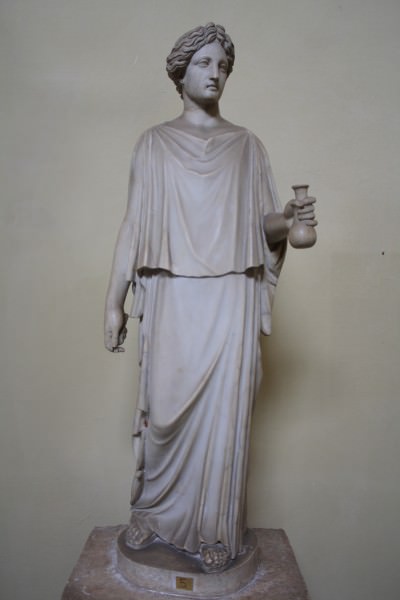
greatest statues of this age were the Statue of Zeus at Olympia and the
Statue of Athena at the Parthenon, both of which were designed by
Phidias. Smaller copies of these statues still exist but the originals
unfortunately were so awe-inspiring that they were stolen by the
Byzantium Emperors from the Parthenon and later destroyed in what is
thought to have been a fire. The sculptures of Greece more than any
other art form are the pure expression of freedom, self-consciousness
and self-determination. These were the values that motivated the
inhabitants of Ancient Greece to defeat mighty Persia and led them to
the development of a model of society that ensured the dignity of every
man within it.
The
greatest statues of this age were the Statue of Zeus at Olympia and the
Statue of Athena at the Parthenon, both of which were designed by
Phidias. Smaller copies of these statues still exist but the originals
unfortunately were so awe-inspiring that they were stolen by the
Byzantium Emperors from the Parthenon and later destroyed in what is
thought to have been a fire. The sculptures of Greece more than any
other art form are the pure expression of freedom, self-consciousness
and self-determination. These were the values that motivated the
inhabitants of Ancient Greece to defeat mighty Persia and led them to
the development of a model of society that ensured the dignity of every
man within it.